
One has places where there are maps and co-ordinates and frontiers and places where people live and breathe and grow and are shaped by the places they live in. Pabington is of the later. It is not merely a name but an atmosphere, a mood, a story, which is told in quite varied ways by different people. To others, Pabington is a small town in the country that is shrouded in fog and history. To others, it represents strength, innovation and eternal beauty.
We shall discuss Pabington at length in this blog post, its origin, its cultural beat, its inhabitants, its architecture, its literary inspiration, and the vision of the author who was its first maker. We shall stroll across its meander walks, perch along its stagnant banks, and formulate what we will hear spoken by its old oak trees. You will know Pabington at the end–you may well know it, indeed you will know it, as though you were living there.
The Origins of Pabington
It is not a story about bricks and mortar, but about imagination. Even the name creates an impression of heritage. It is aged, noble and historical, even when its history is partly a fiction. The linguistic suffix of ton traditionally means a settlement or town and Pabington should have always been a community.
Pabington in its primeval form of conception was thus a rural village between steep green hills and with a small stream flowing through it, and in a narrow valley. It was neither magnificent nor poor. Rather, it was balanced- it was supported by farming, small artisan trades, and a strong sense of belonging. The paving was done with stones of unequal size, and the centre of the civic life was the town square. It was surrounded by a small clock tower, an ancient inn and a marketplace which was used twice a week.
Several years later, Pabington developed the told stories. It turned into a setting of self-development, love stories, family stories, and philosophies. The further it was written the more reality it had. It had traditions, the local legends, and its folklore.
The Natural Beauty and Landscape.
It is impossible to refer to Pabington without referring to its natural environment. A countryside is welcomed into the town that appears to be constantly bathed in golden light. During spring, the wildflowers come out in the meadow painting the hills in light purples, yellows and whites. The smell of fresh earth and dew is in the air. Pabington in summer is not hot but warm. The river turns out to be a meeting place to families and children who skim stones on its surface. Farmers are picking their harvests with broad and sunny skies. Evenings are long and neighbors can linger in the porches and share stories.
Probably the most poetic season of Pabington is autumn. The foliage changes to amber, crimson, covering the pavements. The air is reflective and seems like the town itself reflects to think of how time is passing. Winter is never cruel, despite being cold. The snow falls on the roofs and makes the town square a scene that should be painted. Lantern-light illuminates the cozy windows in the cottages to keep off the cold. The scenery is not merely a scenery, but a character. It molds the beat of life in Pabington, and touches upon its festivals, its occupations, and even its architecture.
Aesthetic Identity and Architecture.
The buildings by Pabington are eloquent without uttering a word. They were mostly made of stone and timber, and are not marred by the monotony of industry. Rooflines are different slightly and chimneys are slanting at slight angles and ivy grows upon the brick walls as though it is bent on restoring history. One of the most identifiable features of the town is the clock tower that is in the center of the town. It is not tall, but one cannot pass by its age and symbolism.
Pabington cottages are characterised by small gardens that are packed with flowers and herbs. Shutters used around the windows are soft greens or blues. The interiors are straightforward yet comfortable with a mix of handcrafted furniture and generation long heirlooms. The same schools of thought of modest beauty permeate the public buildings. The schoolhouse, the town hall and the library are constructed not on grandeur but to carry a purpose and to be cozy. Their shape focuses on neighborhood rather than showbiz.
The Culture and Spirit of Community.
Pabington lives on relationship. It is the type of location where all people are familiar with each other not because they have to, but rather because they are sincerely interested. Marriages, births, and losses are communal experiences and they are incorporated in the memory of the town. The calendar year is characterized by festivals. The Spring Fair marks the time of renewal in the form of music, dancing and handcrafted items. The Harvest Festival celebrates the farmers, the land, with communal meals made of local food. During winter, there is a Lantern Night parade that lights up the streets with the lanterns light which is a sign of hope even in the darkest times.
Pabington education is not just limited to school. Kids are taught by older people, craftsmen teach apprentices and storytelling is something that is held in high esteem. The evenings are usually spent in the old inn as we listen to the stories of the past with hopes of the future. The culture of the town is based on the simplicity. Contribution is considered to be a measure of success and not wealth. Kindness and reliability make you earn respect not the status.
The Writer Behind Pabington
In the backdrop of all the imagined worlds is a creator. The writer created Pabington to show her interest in the silent corners of the world and human strength in every detail. The author imagined that Pabington would be an escape of the chaos of the modern world: a place where such values as integrity, patience and empathy could thrive: The writer was attracted to small towns and countryside since a tender age. Wandering in the country trails, one thought of the time and place. The author held the view that environments needed to be living things, nearly breathing and that settings had a significant impact on the character development.
In both interviews and essays the author frequently referred to Pabington as a memory and a hope. It was motivated by works of the real world incorporated in pieces but put together into something completely uncommon. The author did not want to make something perfect. Rather, Pabington is full of failings, misunderstandings among neighbors, times of torment and intergenerational challenges. It is authentic due to these flaws. Lyrical description, deep respect to the ordinary life, and introspective dialogue are characteristic of the style used by the writer. By using Pabington, the author encourages the reader to relax, look at the details, and discover a purpose in normal communication.
Themes Probed by Pabington.
Pabington is the canvas of a variety of themes. The theme of the lapse of time is one of them. The clock tower, the change of seasons and even the homes of various generations are all symbolic of continuity and change. Belonging is also another theme. The characters who come to Pabington usually come in a displaced or unsure manner. With time, they gain acceptance and a meaning in the society. The town is likened to emotional homecoming.
Another important role is skillfulness. Pabington has its problems economic depression, natural calamities, personal tragedies but it survives. Its residents also provide the strength of the entire town to adapt without losing its identity. Lastly, one has the theme of simplicity. Pabington is a reminder that in our fast, busy, and hectic world, fulfillment may be found in the mundane, in relationships and in contemplation.
Pabington in Modern Context
Pabington is not trapped in the past, although her work is traditional. The author slowly added some hints at modernity renewable energy projects, the small library archive on computers, and green methods of agriculture. These additions are as a result of a belief that progress and preservation should not be two opposite entities.
Young people in the town occasionally migrate to other cities, in search of prospects and adventure. Others come back with different ideas and perceptions. This repetitive migration supports the motif of the growth without leaving. The contemporary development of Pabington reflects the tension in the real world development and heritage. It poses questions of how innovative communities can be able to accept history and innovate.
The Effective Emotions of Pabington.
Pabington is repeatedly said to comfort the readers. Its slow beats are a relief during the frequency of time. The meticulous descriptions stimulate mindfulness, and one will notice simple things, like the way it sounds when it rains on the slate roof or how warm the fresh bread at the bakery will feel.
The hypnotic appeal of the town is based on its universality. Although fiction, Pabington echoes most of the human desires: the desire to be seen, to belong, to contribute, and to be remembered. It brings about introspection also. By means of characters, the readers are challenged by their priorities. What does success mean? What defines home? But what is a measure of a well-lived life?
The Legacy of Pabington
The town has assumed a life beyond its maker as the stories of Pabington keep on spreading. Readers come into their own conception of its streets and fields. There are those who do art which is influenced by its sceneries. Spin-off tales are written by others, and its universe is expanded.
The author has shown appreciation towards this mutual development. When Pabington gets out into the world, he is no longer the exclusive property of its creator. It is turned into a communal imaginary space. The timeless nature of Pabington is in its flexibility. It may be a nostalgia to some, aspiration to others and reflection to many. Its heritage is not marked by a number of stories but the emotional ties that it produces.
Frequently Asked Questions.
What is Pabington?
Pabington is an imaginary town that has been invented as a well-developed environment surrounding tales that reflect upon the theme of community, resilience, and belonging. It serves as a story background as well as a symbolic reflection of eternal values.
Is the location of Pabington a fact?
Although inspired by the aspects of the rural towns and countryside landscape, Pabington is not a direct copy of some single real life location. It is a creation that is created as a combination of imagination and observation.
Who created Pabington?
Widely inspired by the life of a small town, nature, and the intricacy of emotions of ordinary people, Pabington was created by a writer who was strongly motivated by nature and its beauty. The author imagined the town as the place of contemplation and narration.
Which genre does Pabington belong to?
A story based in Pabington typically belongs to the genre of literary fiction; it can include aspects of romance, drama, historical commentary and philosophical discussion.
Why is Pabington so appealing to the readers?
Pabington identifies with the readers since it adopts universal human experiences. Its emphasis on connections, development, and society cuts across cultures and generations.
Is Pabington a changing person?
Yes. Though traditional, Pabington develops slowly. Ideas, technologies as well as outlooks are brought up without losing respect to heritage.
Is Pabington a metaphor?
Absolutely. Some of the interpretations of Pabington are emotional homeland, inner peace, or the perpetual power of community ties.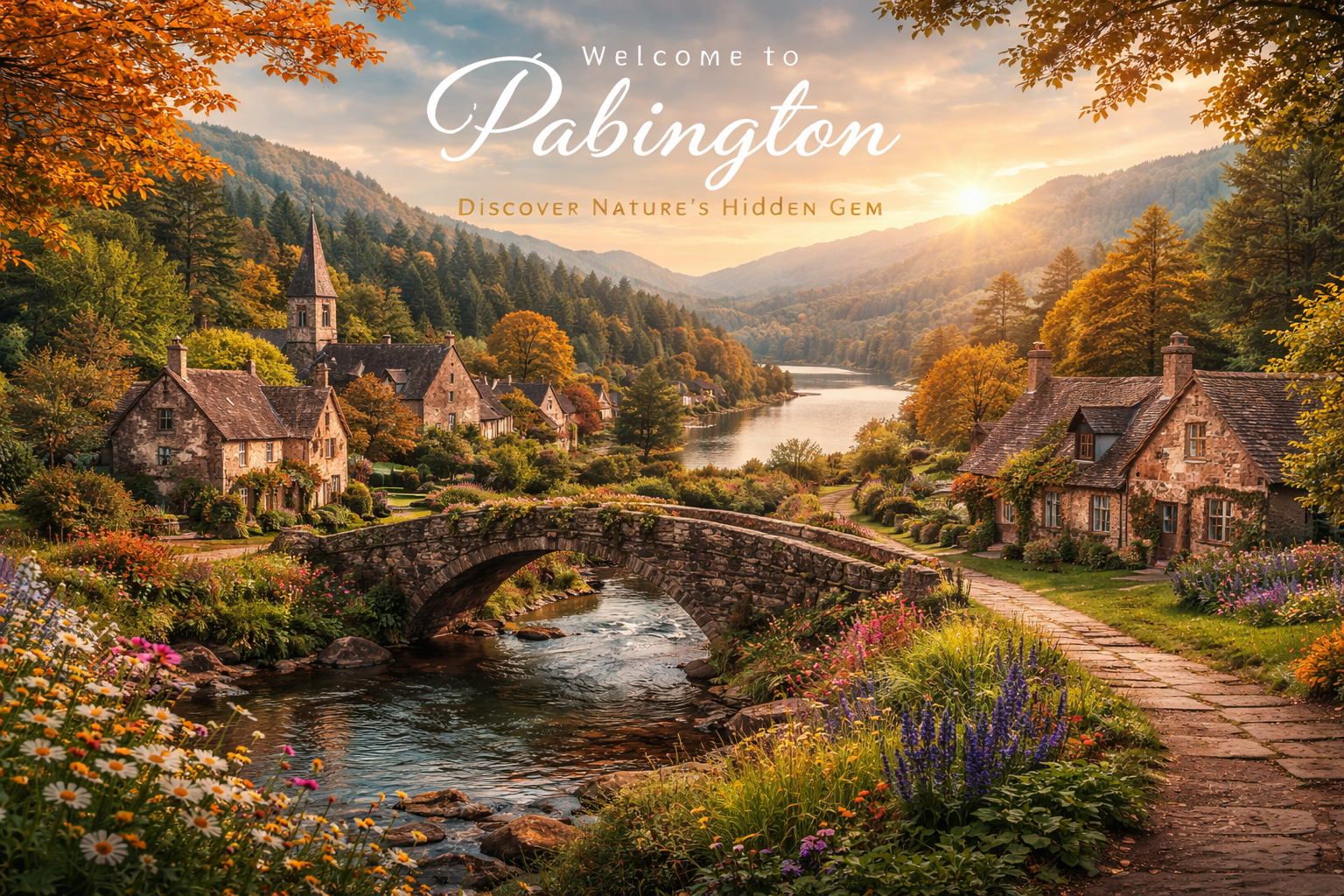
Conclusion
Pabington is not just a name of the fictional town. It is a well-wefted blanket of scenery, structure, civilization, and people. Everything, down to its cobbled streets to its golden fields, has its purpose. It challenges the readers to stop, look, and relate to the essential values that may be lost in the pursuit of the modern world.
Pabington is a masterpiece in the art of setting as a story-telling tool through the eyes of its author. It shows that a location real or imagined can be used to form identity, foster resilience, and promote contemplation. Pabington provides a different pace in a world that is usually chaotic and in a rush. It teaches us that belongingness is established gradually, beauty is found in plain things and that time, though unstoppable, leaves room to meaning. In a novel or an essay, in the darker and more secretive retreats of the imagination, Pabington lives. It is patiently awaiting the arrival of every visitor, and is willing to retell its tales.
About the Writer
The author of Pabington is a narrator who is keenly committed to the investigation of the silent power of normal lives. The writer is obsessed with small-town landscapes and close human interactions, which makes the storylines of the narratives both eternal and touching. Using the rural scenery, real life experiences, and speculative observations, the author adds warmth and depth to each scene.
The writer is renowned with a lyrical writing style and contemplative characterization, as he is convinced that people are made in places and places are made in people. The writer does not just set a scene, he/she simply builds a breathing world where the reader can stop and breath and find the beauty in simplicity again through Pabington. Most importantly, empathy, nostalgia, and a wish of the writer to remind the readers of the idea that the smallest communities are the ones that bear the largest stories lead his work.